Duped Again! Another Bullshit Artist Faking Their Talent Audition.
There is an old man named Arthur Hayes, who never picked up a guitar. He never walked out on the stage in front of a panel of judges, never got told his voice stopped the room, never had a childhood, a hometown, or a single Sunday spent in a real pew. He doesn't exist. And, right now he has hundreds of thousands of people who think he does.
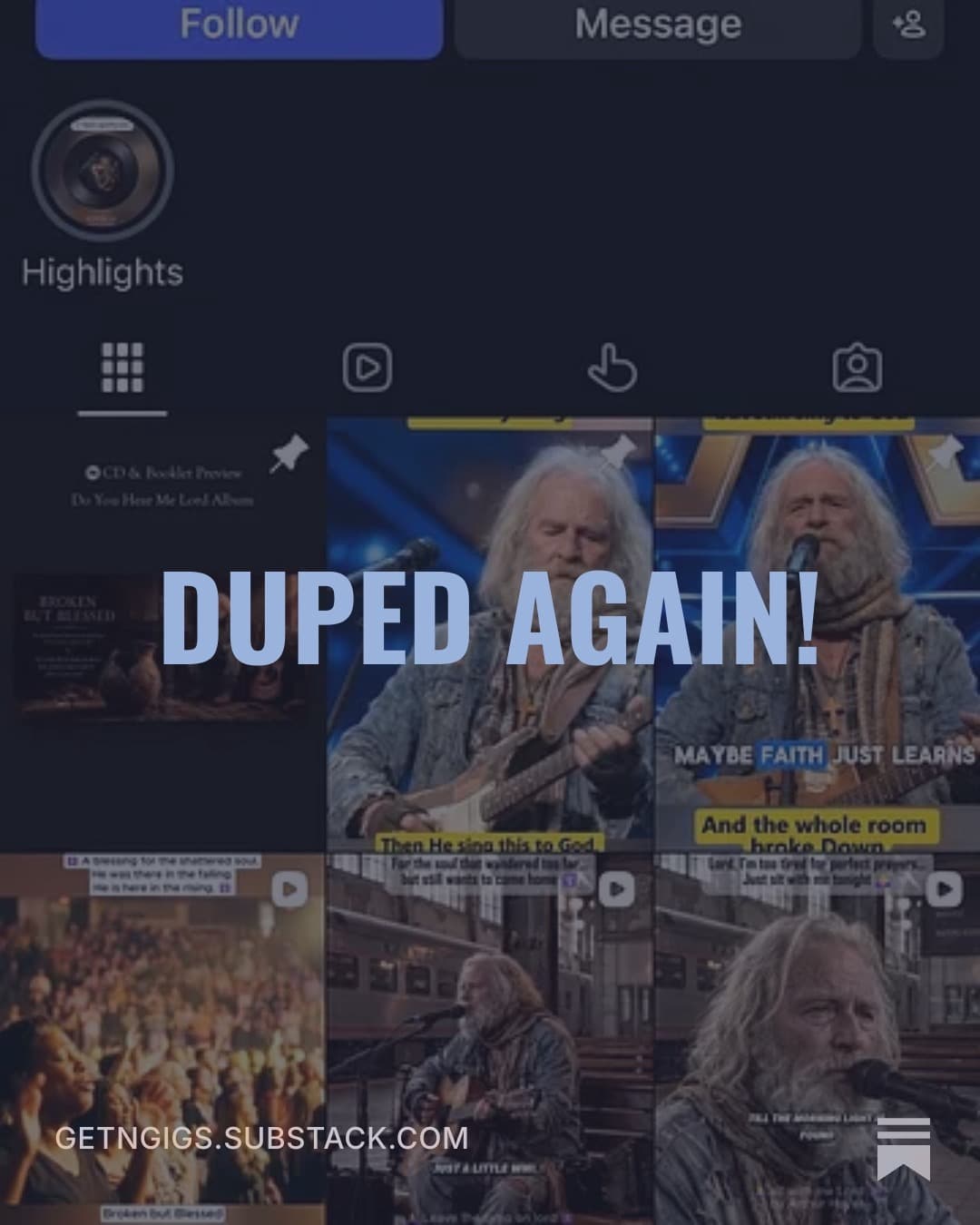
Gravel and Grace (also uploaded as Arthur Hayes, Solomon Hayes, Silas, Thorne, and Michael Bennett) is an AI generated act running across Instagram, Spotify, Apple Music, and YouTube. The same character, more or less, recycled across accounts: an elderly man, long white hair or dreadlocks, a weathered face, a guitar, a scarf, a wooden cross. One version of the profile has 730,000 Instagram followers. Another has 179,000 YouTube subscribers. The songs run millions of streams. " Do you hear me, Lord" alone has over 3,000,000 plays. None of it is real, and a lot of it is built specifically to look like a moment that never happened.
The Fake Audition
Several of the video thumbnails put this fictional man on a stage with the unstable blue backdrop of a widely televised talent show, the kind of lighting rig that reads instantly as " this person just got discovered". One goes further. It shows a face that is unmistakably built to be Simon Cowell, mid gasp, mouth open, eyes wide, layered into a video with the caption "Old man lost everything but still sings to God" AND "And the whole room broke down" stamped over it in the same yellow click bait text every one of these accounts uses. The post has over 33,000 comments.
Simon Cowell‘s face here is not a real, unaltered clip. If you look closely, all of the AI tells are there: skin with no pores or texture, hair that renders like a texture map instead of individual strands, a symmetry to the expression on his face that no real face would produce. It's a generated or face-swapped likeness not actual footage. But that's not a smaller problem than using the real thing. It's a more precise description of a real one… someone built a synthetic version of a recognizable public figure's reaction to a story about a man who does not exist, specifically, so an audience would believe that a real discovery happened that never did.
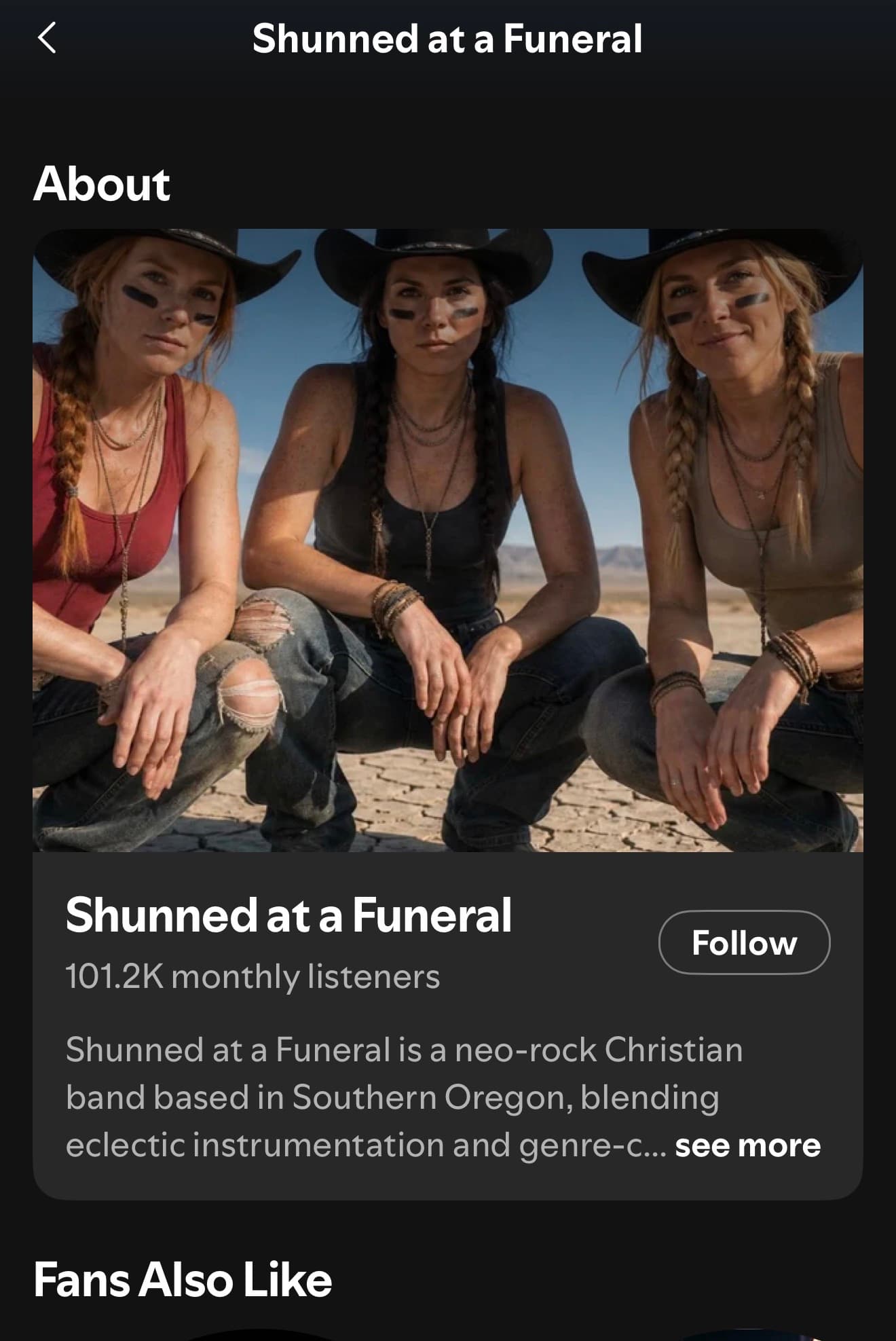
That's the part worth sitting with. This isn't just AI music getting uploaded at scale, which is its own well documented problem, this is a fabricated backstory constructed around a real television format that people trust. The whole thing is designed to make an audience believe a discovery happened that did not. The account in question doesn't claim to be AI assisted or experimental. It's claiming to be an actual person, a person with grief, with faith or, as we've written about before with other fake bands, a childhood in Oregon or a story about growing up on a cattle ranch. Arthur Hayes doesn't have a hometown. He has a prompt!
Why Christian Music Specifically?
This isn't random. Look at the actual content: " Lord, I can't save myself", "Sit with me, Lord", and "Leave the lamp on Lord". Cross imagery, glowing in the background of nearly every cover. Bio lines like "Finding Grace in the Dust of Grief". Captions asking " Which deserves a song tonight? The love we lost, or the life we survived?" Hospital beds. Church windows. Raised hands in a crowd.
Christians listeners are, as an audience, unusually generous with engagement. They comment amen. They share things that move them. They don't assume a stranger on the Internet is lying to them about grief or God, because that's not how most people are raised to engage with faith content. That generosity is precisely what's being harvested here. The algorithm rewards comments and shares, so an operation going for max reach is going to aim itself at whichever audience responds most sincerely. Right now, that's landing hard on Christian listeners specifically, and it's worth calling out instead of pretending this is a generic AI music story that happens to touch every genre equally.
There's also a fairly direct scripture problem with the fabricating of a person's grief and faith to sell streams. Whatever you believe about AI as a tool, inventing a fake human's relationship with loss and God, to make money off people who take that seriously, is a different act than writing a song with the help of software.
Is This Prosecutable?
Here's where I want to be especially careful, because there are two different legal questions tangled together with this, and they don't have the same answer.
"ALTHOUGH THE SONGS AND LISTENERS WERE FAKE, THE MILLIONS OF DOLLARS SMITH STOLE WAS REAL. MILLIONS OF DOLLARS IN ROYALTIES THAT SMITH DIVERTED FROM REAL, DESERVING ARTISTS AND RIGHTS HOLDERS."
US ATTORNEY JAY CLAYTON
Streaming royalty fraud does have real prosecutorial precedent. In September 2024, Michael Smith was indicted by the Department of justice for allegedly generating up to 661,000+ fake streams a day using AI generated songs and bot account listeners, stealing roughly $10 million in royalties from the pool that real artists depend. He pleaded guilty in March 2026 to one count of conspiracy to commit wire fraud, agreeing to forfeit over $8 Million. As of this article, the outcome of his sentencing has not been by the court The Department of Justice was explicit about the theory: "Although the songs and listeners were fake, the millions of dollars Smith stole was real. Millions of dollars in royalties that Smith diverted from real, deserving artists and rights holders". This case settles the basic question. Gaming the royalty pool with AI generated catalog material and artificial streams is wire fraud, and it is being prosecuted as such.
I am not trained in the art of social media and cannot tell whether "Gravel and Grace" specifically is running artificial streams, versus simply extracting a larger number of real human listeners. What I can say is that real people are being deceived, and the end result is still diverting money away from real artists.
Faking a televised discovery moment is a separate question entirely, closer to identity and consumer deception rather than royalty fraud. I am not well-versed in all of the laws surrounding using someone's likeness but there are a patchwork of state laws, plus the "No Fakes Act", a bipartisan bill that has been introduced in Congress that would create the first federal right of publicity against unauthorized AI generated digital replicas of a person's voice or image. Currently, this bill has not passed. Until it does, or until a state rate of publicity claim gets brought against a specific account for a specific fabricated likeness, "can this be prosecuted?" does not have a clean yes.
So, does fabricating a human being, complete with a bullshit, national talent show discovery moment to extract royalty payments and engagement from a trusting audience constitute fraud in the moral sense? That answer seems undeniable. Is it prosecutable? Until specific laws get passed to protect actual, recorded music, probably not.
Why This Is the Whole Reason getNgigs Exists
Our mission at getNgigs is to elevate the spirit of mankind by protecting the heartbeat of live music. That's not a tagline we picked because it sounded good. It's a description of what's actually at stake here.
A heartbeat means a person is in the room. It means a musician loads their own gear, replies to a booker, shows up on a weekday night to a half-full room and plays like it's full. It means a fan can walk up after a set and shake the hand of the person who wrote the song. Arthur Hayes cannot do any of that, because Arthur Hayes has no hands to shake. He has never loaded an amp into a car. He will never stand in a room and feel it go quiet. He remains a prompt.
getNgigs is built entirely around the artist's actual heartbeat. Every profile represents a real person who can be booked, who has a calendar, who responds to a venue's message, who shows up. That's not a side feature. It's the whole design. An AI-generated act with no gig history, no booker relationship, and no physical body in a room simply has no reason to exist on this platform, and never will.
Keep it real friends!