You're Not Listening to Who You Think You Are
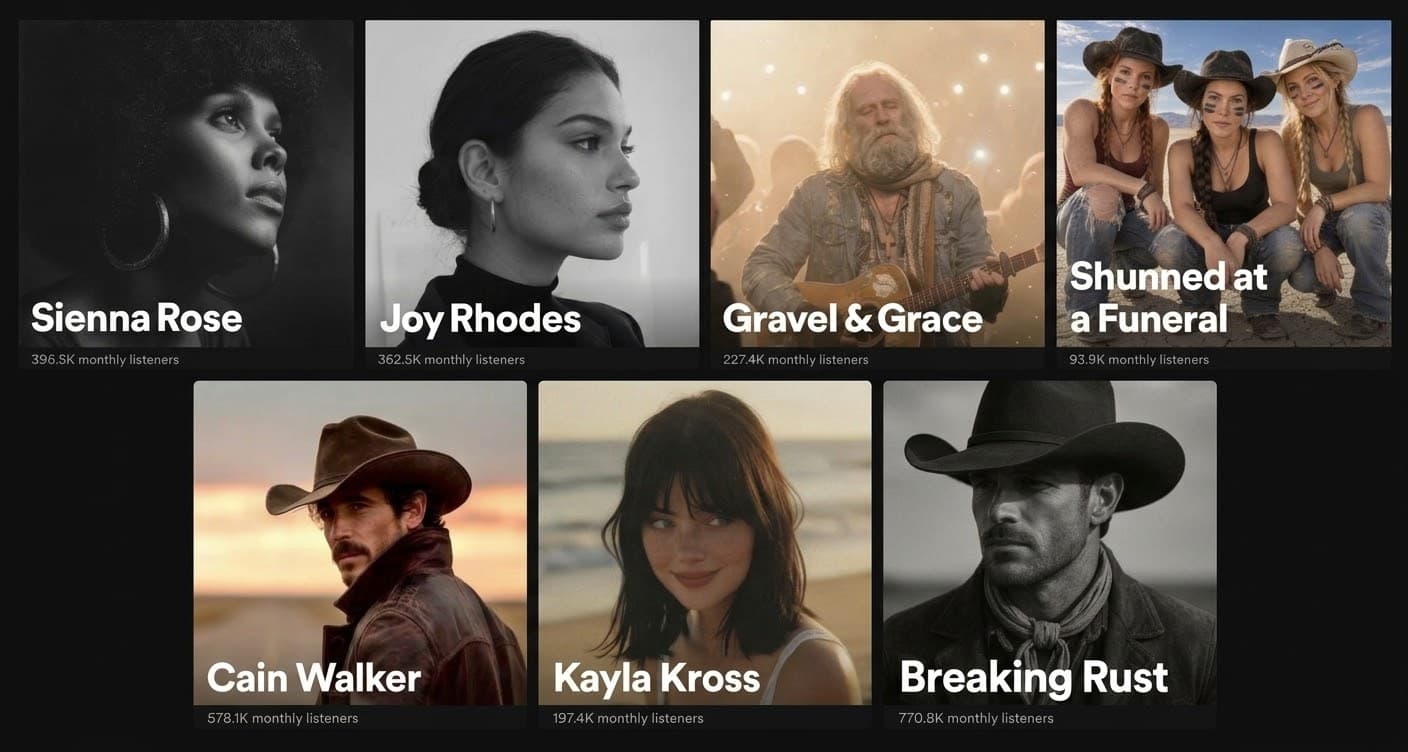
Joy Rhodes has 364,000 monthly listeners on Spotify. She has never written a lyric, recorded vocals, or taken a breath. Neither has Shunned at a Funeral, Kayla Kross, Sienna Rose, Arthur Hayes, or Breaking Rust despite the 770,000 people who follow him on Instagram.
They are not artists. They are prompts, uploaded at industrial scale, quietly pulling money out of a royalty pool that real musicians depend on to survive.
If you have not checked who is actually behind the songs in your playlists, now is a good time to start.
A Trust Built to Be Exploited
Music carries weight most media does not. It is the soundtrack to a hard morning, a long drive, a quiet moment of prayer. When you press play, you are trusting that a person is on the other end of that recording, someone who spent late nights and real sacrifice getting those notes right.
That trust is exactly what is being exploited, and it is happening disproportionately in Christian, worship, and devotional genres. Listeners who come to that music with an open heart are not running background checks on the artist's biography. They are not cross-referencing tour dates. They are simply letting the music do its work, and that is precisely the vulnerability these operations were built to target.
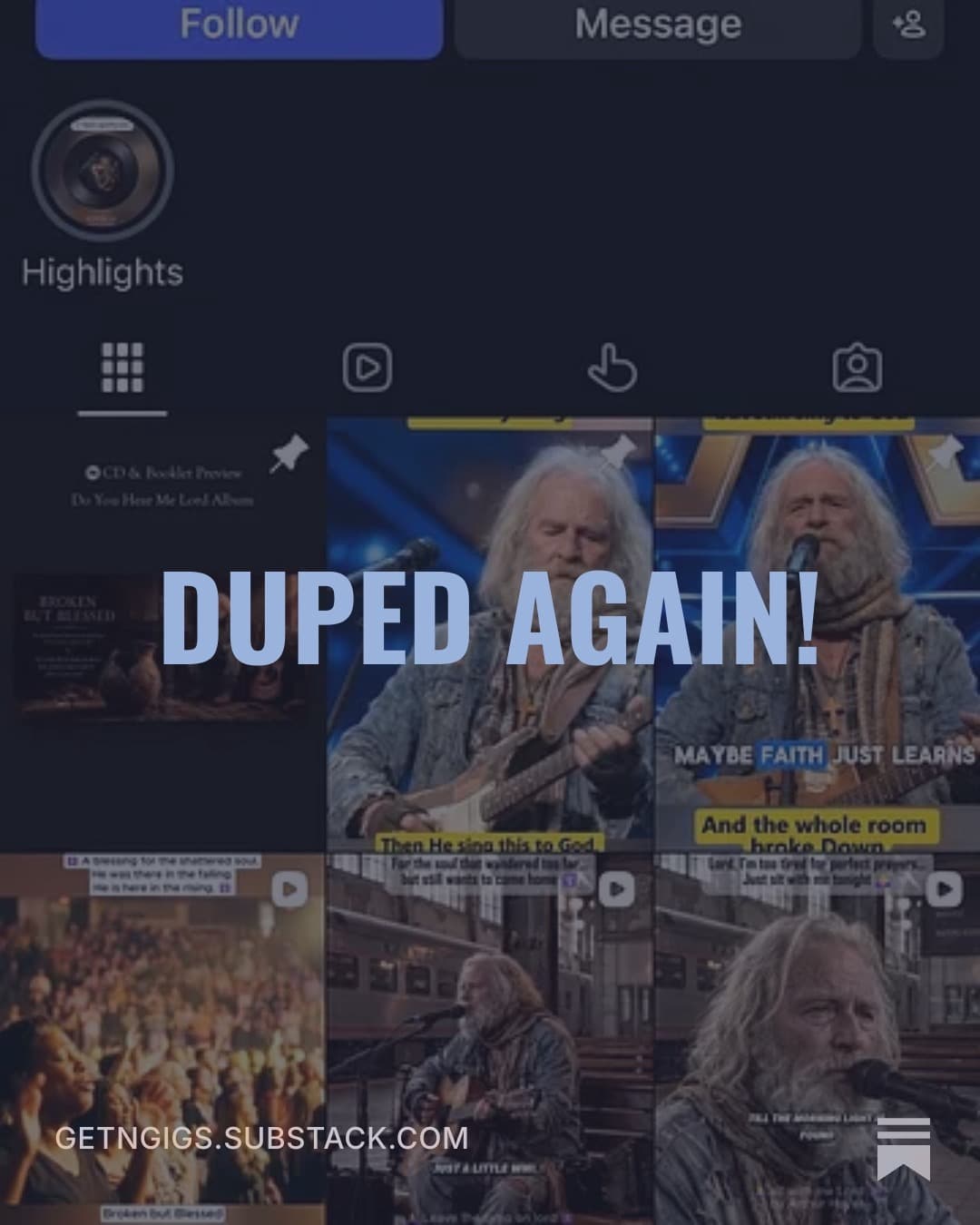
The AI artist accounts target our emotions. Faith, redemption stories and fantasy. We want to believe that the old man rose from ruin to become a superstar, we lust after the handsome Outlaw Country star's AI image (Cain Walker is so good looking), or both, Shunned at a Funeral (see our blog "Guess who will never have a profile on getNgigs"), super attractive "Christian" musicians that supposedly grew up on ranches in the American West. This is the play and WE are paying for it.
Read the full story on Shunned at a Funeral: Guess who will never have a profile on getNgigs.
How the Money Actually Moves
Streaming royalties come from a shared pool. Your subscription fee does not go directly to the artists you play; it goes into a pool that gets divided based on total stream share across the platform. Every stream AI bullshit gets dilutes that pool and pulls payouts away from REAL musicians who are actually touring, recording, and building careers.
Our most recent article, "Duped Again!" mentions the first real prosecution of AI music. In 2024, Michael Smith was indicted for allegedly generating over 661,000 fake streams a day using AI-generated songs and bot listeners, diverting roughly $10 million in royalties. He pleaded guilty in March 2026. (See "Duped Again!") That is the clearest statement of the actual harm. The fraud is synthetic. The financial damage to working artists is not.
Read the full breakdown: Duped Again!.
Why This Matters Beyond the Royalties
The deeper cost is not just dollars. When synthetic profiles crowd algorithmic recommendations, real independent artists lose visibility they cannot buy back. Listeners get trained to accept manufactured content as a substitute for an actual human perspective. And the basic premise of music as a form of connection between people starts to erode.
This is the exact problem getNgigs was built to address, from the other direction. Rather than trying to police what shows up in a streaming catalog after the fact, getNgigs is built around a simple standard: every profile on the platform represents a real, bookable musician. Someone with a gig calendar, a booking history, a venue relationship, and a body that shows up to load gear and play a set. An AI-generated act cannot do any of that. It has no calendar to fill and no booker to answer. That is not an accident of the platform's design. It is the design.
How to Vet What You're Hearing
You do not need to abandon the genres you love. You need to get more intentional about who you are actually supporting:
- Check for a real footprint. Active social media, a website, footage from an actual live performance. A static profile photo and nothing else is a warning sign.
- Watch the release cadence. An "artist" releasing dozens of polished singles a month with generic cover art is a pattern associated with AI content farms, not a working musician's actual output.
- Read the credits. Real recordings carry real names: songwriters, producers, engineers. Blank or vague metadata is a signal worth taking seriously.
- Support the artists you confirm are real, directly. Buy the merch, attend a live show, follow them where they actually engage with an audience.
If you are a working musician, this is the moment to make sure your booking presence reflects that you are real and active. Build your profile on getNgigs and put your gig calendar where venues and fans can actually find it.
If you book talent for a venue and you are tired of sorting signal from noise, see how getNgigs verifies real, bookable artists before you spend another hour vetting a profile that turns out to be a prompt.
If you have a story about getting sucked in by an AI artist's story share your story with us in the comments, we're keeping a running account of what we're seeing. Hopefully, it helps sharpen the picture for everyone else reading.
Keep it real Friends!